200 Vintage Fashion Coloring Pages: A Practical Guide for Creators and Colorists
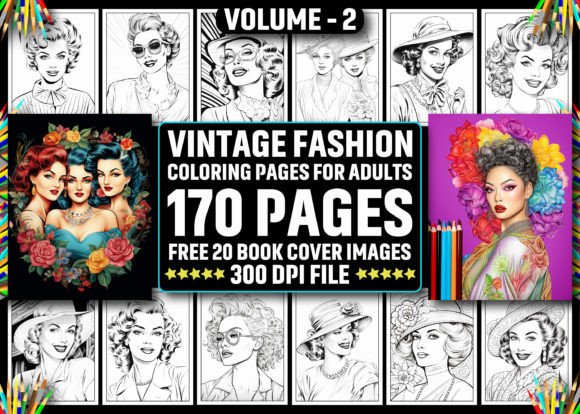
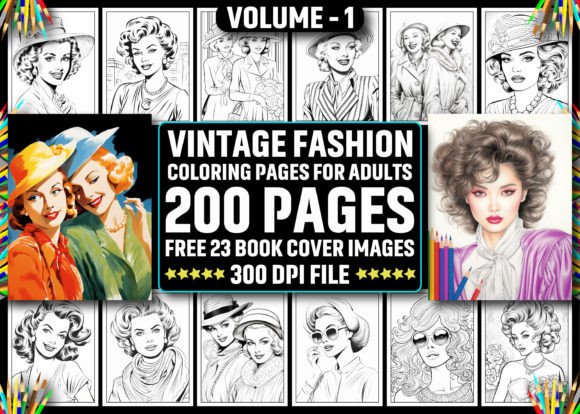
For adults seeking both creative expression and historical charm, 200 Vintage Fashion Coloring Pages offers a focused, high-resolution resource rooted in fashion history—from flapper silhouettes and 1940s tailoring to 1950s full skirts and 1960s mod patterns. Unlike broad-themed adult coloring books, this collection centers exclusively on vintage apparel, accessories, and period-accurate poses, making it especially useful for designers, educators, KDP publishers, and hobbyists who value stylistic consistency and print-ready quality.
What Sets This Collection Apart
The core distinction lies in its dual-purpose design: it functions equally well as a personal coloring experience and as production-ready interior content for self-published books. Each of the 200 pages is delivered in three formats—PDF, JPG, and PNG—at 300 DPI, all sized for standard printing (A4 and 8.5×11″). That means no scaling compromises or pixelation when printed at home or through a print-on-demand service like Amazon KDP.
Unlike many digital coloring packs that offer only one file type—or lower-resolution JPEGs meant for screen use—200 Vintage Fashion Coloring Pages provides flexibility without requiring technical workarounds. The inclusion of transparent-background PNGs, for example, allows users to layer illustrations over custom backgrounds or integrate them into composite designs. The PDF files are pre-formatted with crop marks and bleed space, reducing prep time before sending to a printer.
How It Compares With Other Vintage-Themed Resources
Most vintage fashion coloring books on the market fall into two categories: mass-produced physical books (often with limited page counts and fixed layouts) or low-resolution digital downloads bundled with minimal formatting options. In contrast, 200 Vintage Fashion Coloring Pages sits between those extremes—offering the volume of a large workbook while retaining the adaptability of raw digital assets.
Compared to royalty-free illustration libraries (e.g., Shutterstock or Adobe Stock), this collection has tighter thematic cohesion and consistent line weight, which matters for coloring usability. Stock platforms may offer individual vintage fashion vectors—but sourcing, licensing, and unifying 200+ images across decades requires significant curation effort. Here, that work is already done.
When weighed against free printable collections found on blogs or Pinterest, the difference becomes clearer in reliability and resolution. Many free pages are scanned from old publications or traced from low-quality sources, resulting in inconsistent linework or faint outlines that don’t hold up under color application. These 200 pages maintain clarity even when enlarged slightly or printed on textured paper—a practical advantage for serious colorists or small-batch publishers.
Practical Use Cases and Realistic Fit
This collection shines in specific scenarios:
- KDP Interior Development: You can generate six distinct book interiors using subsets of the 200 pages—each themed by decade (e.g., “1920s Jazz Age,” “1950s Dior Silhouettes”) or category (hats, gloves, evening gowns). Because all files are print-ready, you avoid costly layout revisions or last-minute rasterization issues.
- Classroom or Workshop Materials: Art teachers or fashion history instructors can assign historically grounded drawing prompts without needing copyright clearance—since these are original line art designed for reuse.
- Personal Skill Building: Adults practicing fine motor control, mindfulness, or observational drawing benefit from clean, balanced compositions that emphasize garment structure—darts, seams, pleats—rather than decorative clutter.
It’s less ideal if your goal is highly stylized or cartoonish fashion illustration. The line work prioritizes realism and period accuracy over exaggerated proportions or whimsical abstraction. Similarly, if you need editable vector files (e.g., SVG or AI), this set won’t meet that need—it delivers raster-based assets only.
Understanding the Book Cover Add-On
The included 23 Premium Book Cover Images are not generic templates but curated, high-resolution PNGs featuring vintage typography, ornamental borders, and era-appropriate motifs (Art Deco flourishes, mid-century sunbursts, Victorian scrollwork). Each is provided at 300 DPI with transparent backgrounds, enabling easy resizing and layering in Canva, Adobe Photoshop, or Affinity Publisher.
That level of polish matters when competing in crowded KDP categories. A cover built from scratch using free fonts and stock photos often lacks visual cohesion; these covers were designed to complement the interior style—not just match it superficially. Still, they’re not locked to any single title or subtitle. You retain full rights to edit text, adjust colors, or combine elements across multiple covers.
Tradeoffs to Consider Before Downloading
While the breadth and resolution are strengths, there are natural tradeoffs to acknowledge:
- No grayscale or shaded base layers: All pages are pure black-and-white line art. If you prefer starting with subtle tonal guidance (e.g., soft shadows or fabric folds suggested in light gray), you’ll need to add those manually.
- Limited diversity in body types and ethnic representation: Like many vintage reference sources, the figures reflect predominant styling conventions of their eras. Modern creators may wish to adapt or supplement certain pages for broader inclusivity.
- No instructional content: There are no annotations, historical notes, or technique tips embedded in the files. That’s intentional—it keeps the resource flexible—but means educators or beginners will need to source contextual material separately.
When to Choose This Over Alternatives
200 Vintage Fashion Coloring Pages makes sense when you prioritize efficiency, consistency, and production readiness over novelty or interactivity. For instance:
- You’re launching a series of niche KDP coloring books and want to test demand across sub-themes (e.g., “Vintage Swimwear,” “Retro Workwear”) without commissioning new artwork each time.
- You're an independent designer building a portfolio of fashion-focused printables and need reliable, licensable assets that align with a cohesive aesthetic.
- You enjoy coloring but find many modern books visually overwhelming—the clean, medium-weight lines here provide breathing room for colored pencils, gel pens, or watercolor washes without bleeding or muddying.
Conversely, if you're looking for interactive features—like scannable QR codes linking to video tutorials—or need ADA-compliant high-contrast versions for low-vision users, this isn’t the right fit. Likewise, educators needing CCSS-aligned lesson plans or historians requiring primary-source citations would need to augment the collection with external materials.
Making the Most of the Files
Because the package includes PDF, JPG, and PNG versions, users can tailor workflows to their tools and goals. For example:
- Use the PDFs for direct printing or binding into physical journals.
- Import JPGs into Procreate or Clip Studio Paint for digital coloring with custom brushes and layers.
- Overlay PNGs onto textured backgrounds in Canva or Illustrator to create social media graphics or promotional posts.
And because all files are organized clearly within the ZIP folder (by format and numbered sequentially), batch processing—such as renaming or converting for KDP upload—is straightforward, even for users with limited tech experience.
A Balanced Choice for Intentional Creators
In a landscape where digital coloring resources range from disposable PDFs to expensive subscription services, 200 Vintage Fashion Coloring Pages occupies a pragmatic middle ground. It doesn’t try to be everything at once. Instead, it delivers what it promises: a substantial, technically sound, historically grounded set of fashion illustrations—ready to color, publish, teach from, or build upon.
Its value emerges not in flashiness, but in reliability—in knowing that whether you’re printing a single page for quiet reflection or assembling a 120-page KDP title, the assets will perform consistently. That kind of predictability matters most when time, budget, or creative energy is limited.