Flowers Heart Coloring Pages: A Versatile Digital Asset for Creative Entrepreneurs and Educators
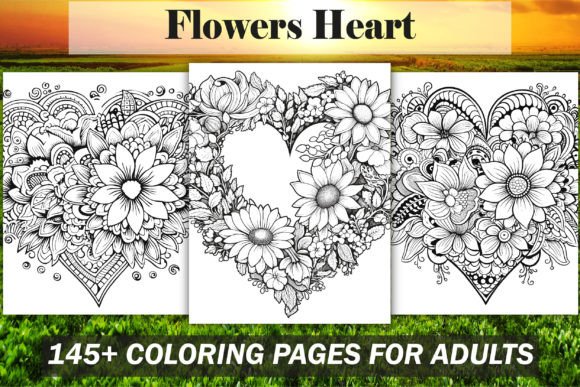
Flowers Heart Coloring Pages represent more than a trend in adult relaxation or children’s creative development—they reflect a convergence of therapeutic design, commercial practicality, and scalable digital publishing. At its core, this collection is a thoughtfully structured set of 145 original line-art illustrations, each merging botanical motifs—roses, peonies, daisies, vines—with the symbolic, universally resonant shape of the heart. But its real value emerges not from aesthetics alone, but from how seamlessly it integrates into diverse professional workflows: from Amazon KDP interior formatting and print-on-demand (POD) product creation to classroom resource development and brand-aligned book cover design.
Why This Bundle Fits Real-World Creative Workflows
Unlike generic clipart or fragmented single-page downloads, this Flowers Heart Coloring Pages bundle is engineered for immediate operational use. Every illustration arrives in three production-ready formats: high-resolution PNG (transparent background), JPEG (optimized for quick preview and web embedding), and print-standard PDF (A4 and US Letter—8.5″ × 11″). That means no time lost converting files, adjusting DPI, or troubleshooting bleed margins. For KDP authors building coloring books, the interiors are pre-sized, pre-cropped, and pre-tested at 300 DPI—ensuring crisp lines even when printed on standard matte paper. For educators preparing mindfulness activities, the PNG files can be dropped directly into Google Slides or Canva templates without background interference. For designers developing custom greeting cards or journal inserts, the vector-like clarity supports clean scaling up to poster size without pixelation.
Design Integrity Meets Functional Flexibility
The 145 designs avoid repetition through intentional variation—not just in floral species, but in structural composition. Some pages feature tightly interwoven hearts filled with delicate hawthorn sprigs; others use negative space strategically, placing a single bold heart outline amid swirling lavender stems. Several incorporate subtle geometric framing—mandala-inspired borders, tessellated corners, or symmetrical radial layouts—that appeal to users seeking meditative focus. Importantly, line weight remains consistent across all pages: 1.2–1.5 pt strokes ensure visibility when photocopied or printed on lower-end home printers, while still allowing fine detail for advanced colorists using gel pens or watercolor pencils.
This consistency isn’t accidental—it reflects an understanding of both user behavior and platform constraints. Amazon KDP, for example, rejects interior files with inconsistent page sizes or embedded fonts. This bundle sidesteps those pitfalls entirely: every file adheres strictly to 8.5″ × 11″ dimensions, uses only standard black-and-white line art (no RGB/CMYK confusion), and contains zero external dependencies. That reliability translates directly into faster upload cycles, fewer rejection loops, and earlier time-to-market—a critical advantage when launching seasonal titles (e.g., Valentine’s Day bundles in December or Mother’s Day editions in April).
Applications Beyond Coloring Books
While “coloring book” is the most visible use case, the Flowers Heart Coloring Pages bundle serves several less obvious—but equally valuable—functions:
- Educational scaffolding: Elementary art teachers use individual pages as tracing templates to build fine motor control. Special education practitioners adapt them for sensory regulation—pairing tactile coloring with breathing exercises or emotion identification (“Color the heart red if you feel excited, blue if calm”).
- Branded content development: Wellness coaches embed select pages into client workbooks as reflection prompts (“Draw what love feels like in your body”). Therapists print them on pastel cardstock for in-session grounding tools.
- Product diversification: Print shop owners layer PNGs over textured backgrounds to create downloadable wall art packs. Stationery brands integrate simplified versions into printable planner stickers or washi tape mockups.
- Course and workshop materials: Online instructors license specific pages for inclusion in paid digital courses on mindful creativity, offering students printable takeaways that reinforce lesson concepts visually.
Each application leverages the same foundational asset—the clean, adaptable line art—but tailors delivery and context. That modularity reduces overhead: one purchase supports multiple revenue streams without requiring additional licensing negotiations or redesign effort.
Technical Considerations for Commercial Deployment
For creators targeting Amazon KDP or other POD platforms, technical compatibility is non-negotiable. This bundle addresses key pain points observed across thousands of failed uploads:
- No embedded fonts or layers: Files are flattened raster images—no Photoshop layers, Illustrator paths, or font-based text that could render inconsistently across devices.
- Optimized file naming: Each PNG and JPEG uses descriptive, SEO-friendly naming (e.g., flowers-heart-peony-vine-042.png), enabling bulk import into design tools and simplifying inventory management in digital asset libraries.
- Consistent metadata: While EXIF data is stripped for privacy, the PDF includes embedded document properties (title, author, keywords) aligned with KDP’s internal search algorithms—helping titles surface more effectively in category browsing.
- Print-safe margins: All pages maintain a minimum 0.25″ margin around critical elements, preventing accidental cropping during binding or trimming—especially important for spiral-bound or hardcover editions.
These aren’t cosmetic enhancements—they’re risk-mitigation strategies. A single rejected KDP upload triggers a 24–48 hour review cycle. With 145 pages ready to go, creators avoid that bottleneck entirely and instead focus energy where it matters most: cover design, description copy, and keyword targeting.
User-Centered Design Across Age Groups
Though marketed for adults, the Flowers Heart Coloring Pages bundle demonstrates thoughtful age-layering. Approximately 35% of the designs feature bolder outlines, simplified petal structures, and generous interior spacing—making them accessible to children ages 6–10 practicing scissor skills or early color theory. Another 25% lean into intricate linework, micro-patterns, and overlapping botanical layers ideal for teens and adults seeking sustained focus. The remaining 40% occupy a deliberate middle ground: complex enough to engage experienced colorists, yet legible and forgiving for beginners or those managing hand tremors or arthritis.
This tiered approach expands market reach organically. A teacher purchasing for a mixed-grade classroom doesn’t need separate bundles for third and eighth graders. A grandparent buying for intergenerational activity can choose pages based on current mood or energy level—not preset age categories. That flexibility aligns with modern educational research emphasizing choice-driven engagement over rigid developmental tracking.
Strategic Positioning in a Crowded Niche
The adult coloring market has matured beyond novelty into a segment defined by intentionality. Consumers now seek themes with emotional resonance—not just “flowers,” but flowers *as metaphor*. Hearts signal connection, vulnerability, self-compassion, and relational healing. Combining the two creates built-in narrative hooks: “Healing Through Blooms,” “Love Letters to Yourself,” or “Rooted in Care.” These angles perform strongly in Amazon search because they match long-tail queries (“coloring pages for anxiety relief with floral hearts”) rather than competing for generic terms like “flower coloring pages” (a space saturated with low-DPI, copyright-questionable assets).
Similarly, educators increasingly prioritize resources tied to social-emotional learning (SEL) standards. Pages featuring hearts surrounded by growing vines or blossoms emerging from cracked soil subtly reinforce growth mindset concepts—without requiring explicit instruction. That dual utility—therapeutic + pedagogical—makes the bundle attractive to school district curriculum committees evaluating supplemental materials.
Implementation Readiness Without Compromise
What separates this collection from DIY alternatives is implementation velocity. Creating 145 original, balanced, print-optimized illustrations demands hundreds of hours—even for skilled illustrators. Sourcing royalty-free assets introduces legal ambiguity unless licenses explicitly permit commercial resale (many do not). Curating public domain botanical engravings requires extensive editing to unify line weight and scale.
This Flowers Heart Coloring Pages bundle eliminates those variables. It delivers production certainty: known resolution, verified sizing, documented usage rights, and format redundancy. For a freelance designer building a client’s Amazon coloring book, it cuts interior development time from weeks to hours. For a small business owner launching a subscription box, it provides evergreen content that refreshes quarterly without new illustration costs. For a researcher studying art-based interventions, it offers a standardized stimulus set with documented visual complexity metrics (line count, symmetry score, motif density)—enabling replicable methodology.
In essence, the value lies not in the individual pages—but in the infrastructure they provide. They function as modular, interoperable units within larger creative systems: publishing pipelines, therapeutic protocols, educational sequences, and brand ecosystems. That systemic utility—grounded in technical rigor and human-centered design—is what transforms a set of coloring pages into a durable professional asset.