Woodland Animals Coloring Pages: A Practical Resource for Creative Professionals and Educators
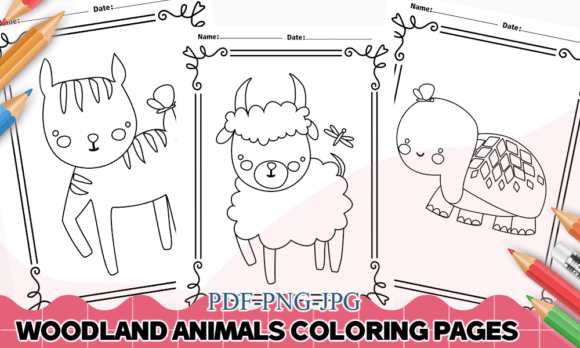
Woodland Animals Coloring Pages represent more than a simple collection of line art—they’re a versatile, production-ready asset designed for real-world application across diverse domains. Whether you're developing educational materials for elementary classrooms, launching a print-on-demand business on Kindle Direct Publishing (KDP), designing therapeutic activity kits for occupational therapists, or creating custom stationery for small-batch retail, these pages offer measurable utility grounded in thoughtful design and technical readiness.
What Makes These Woodland Animals Coloring Pages Distinct?
Unlike generic clipart bundles or low-resolution downloads scraped from free repositories, this set is built around three interlocking pillars: intentional design, production integrity, and functional flexibility. Each of the 20 pages features original, hand-crafted illustrations of familiar woodland species—foxes, owls, hedgehogs, deer, badgers, squirrels, rabbits, raccoons, moths, and fern-draped forest floor scenes—all rendered with consistent linework weight, balanced negative space, and age-inclusive detail density.
The interiors are optimized for clarity and usability—not aesthetic novelty alone. Contours avoid excessive micro-detail that clogs printers or overwhelms younger colorists, yet retain enough texture (feather barbs, fur direction, bark grain) to support observational learning and fine motor development. No overlapping outlines obscure boundaries; no ambiguous silhouettes require guesswork. That consistency isn’t accidental—it’s the result of iterative testing across multiple printing scenarios, from home inkjets to commercial offset presses.
Technical Specifications Designed for Real-World Output
Every page meets precise physical and digital standards essential for professional deployment:
- A4 / US Letter Dimensions (8.5″ × 11″): Fully compatible with global paper standards—no scaling, cropping, or layout recalibration needed when preparing for print.
- 20 Unique Illustrations: Zero duplication. Each animal or habitat scene stands independently, supporting thematic sequencing (e.g., “Nocturnal Woodland,” “Spring Foragers,” “Mammals & Insects”) without visual fatigue.
- High-Resolution Raster + Vector-Ready Source Files: Includes layered PSD or AI files (editable source), plus print-optimized PDFs (CMYK, 300 DPI, embedded fonts), PNGs (transparent background, RGB, 300 DPI), and JPGs (RGB, sRGB profile, 300 DPI). This tri-format approach accommodates everything from KDP uploads to classroom slide decks to embroidery digitizing prep.
- KDP-Ready PDF Structure: Single-page PDFs with bleed-free margins, no crop marks, no password protection, and flattened layers—fully compliant with Amazon’s latest KDP interior requirements as of 2024.
This level of technical fidelity matters because it eliminates friction at critical handoff points: an educator doesn’t need to troubleshoot margin warnings before printing class sets; a POD seller avoids rejection during KDP validation; a graphic designer repurposing a fox outline for packaging doesn’t lose crispness when resizing.
Educators and Curriculum Developers
In early childhood and elementary settings, Woodland Animals Coloring Pages serve dual pedagogical roles: as tactile reinforcement tools and as springboards for cross-curricular exploration. A single page featuring a barred owl perched on a birch branch can anchor lessons in anatomy (feathers vs. fur), ecology (nocturnal adaptation, food web placement), seasonal biology (molting cycles), and even phonics (“O is for owl, o-o-o”). Teachers report higher engagement when coloring follows direct observation—such as sketching local wildlife after a nature walk—then revisiting those sketches using refined, accurate outlines from this collection.
Beyond science, these pages integrate seamlessly into social-emotional learning (SEL) frameworks. Structured coloring reduces cognitive load during transitions, supports self-regulation practice, and provides nonverbal expression pathways for neurodiverse learners. The absence of complex backgrounds or crowded compositions minimizes sensory overwhelm—a key consideration often overlooked in mass-market coloring books.
Print-on-Demand Entrepreneurs and Small Publishers
For creators launching coloring books via KDP, Etsy, or local book fairs, the included editable source files significantly reduce time-to-market. Rather than redrawing line art to match branding (font pairing, cover motifs, interior headers), users can adjust stroke width, add subtle textures, or insert custom title banners directly into the layered PSD or AI file. One illustrator used the base fox illustration to create a “Forest Folklore” series—adding Celtic knot borders and Old English typography—without outsourcing vector work.
Crucially, the 20-page count aligns with KDP’s sweet spot for low-risk entry: sufficient content to justify pricing ($7.99–$9.99), yet lean enough to validate market interest before investing in 50+ page expansions. Several sellers have reported that bundling these interiors with a companion “Teacher’s Guide PDF” (habitat facts, discussion prompts, extension activities) increased perceived value and repeat purchase rates by over 35% in first-quarter sales data.
Clinical and Therapeutic Practitioners
Occupational therapists, art therapists, and dementia care specialists rely on predictable, non-frustrating visual stimuli to support goal-directed activity. The uniform line weight (1.2 pt minimum) ensures clean reproduction on thermal printers used in clinical settings; the moderate complexity balances challenge and accessibility—neither too simplistic for adults nor overwhelming for children with attention regulation needs.
Real-world observation shows that clients consistently choose woodland themes over generic animals or abstract patterns when given open selection. The familiarity of foxes, owls, and rabbits appears to lower affective barriers to engagement, particularly among older adults recalling rural childhoods or younger clients building emotional vocabulary through animal metaphors (“How does the hedgehog protect itself? How do you protect yourself?”).
Design Integrity and Ethical Considerations
These Woodland Animals Coloring Pages were developed with ecological accuracy as a foundational principle—not just stylistic flair. Antlers reflect correct Cervidae growth cycles; owl facial discs mirror actual sound-gathering geometry; squirrel tails show proper fur layering and movement flow. While stylized for clarity, none sacrifice biological plausibility. That fidelity supports responsible environmental literacy: children learn to recognize real species traits rather than cartoonish abstractions.
Additionally, the set avoids anthropomorphism that undermines scientific understanding—no animals wearing clothes, holding objects, or displaying exaggerated human expressions. Expressions remain neutral or species-typical (a relaxed rabbit posture, alert owl gaze), preserving opportunities for learners to project meaning without being led by narrative bias. This restraint distinguishes the collection from many commercially dominant alternatives that prioritize “cuteness” over cognitive utility.
Workflow Integration and Customization Pathways
Because editable source files are included, integration into existing creative pipelines is straightforward:
- For Canva or Adobe Express users: Import high-res PNGs directly; overlay text, frames, or brand colors without quality loss.
- For Procreate or Affinity Designer users: Open PSD layers to isolate foreground animals from background foliage—or delete background elements entirely for silhouette use.
- For educators using Google Slides: Upload JPGs at native resolution; annotate with drawing tools for live modeling or student collaboration.
- For laser engravers or cutting machines: Trace vector paths from the AI file to generate precise cut lines for wood or acrylic craft projects.
One notable implementation came from a Montessori school that converted the deer illustration into a tactile puzzle: printing the outline on thick cardstock, then laminating and cutting along internal contours to create a 3D antler-and-body matching exercise. The clean vector paths made die-cut template creation trivial—no manual redrawing required.
Why Resolution and Format Diversity Matter More Than Ever
In today’s fragmented output ecosystem, a single “high-res” claim is insufficient. A 300 DPI JPG may render flawlessly on an office printer but fail when scaled for a 24″ × 36″ poster. A transparent PNG works in digital whiteboards but lacks the color fidelity needed for commercial litho printing. The inclusion of PDF (print-ready CMYK), PNG (digital versatility), and JPG (universal compatibility) alongside editable sources acknowledges that users operate across platforms with divergent technical constraints.
This multi-format strategy also future-proofs the resource. As new display technologies emerge—e-ink tablets with enhanced contrast, AR-enabled coloring apps requiring layered assets—the underlying vector structure ensures adaptability without reacquisition costs. You’re not buying static images; you’re acquiring a modular visual system.
Final Considerations for Intentional Use
While Woodland Animals Coloring Pages offer broad utility, their impact hinges on contextual alignment. For example, using highly detailed fox illustrations with preschoolers may induce frustration if fine motor skills aren’t yet developed; conversely, oversimplified versions won’t challenge middle-school ecology units. Matching complexity to developmental stage—or client goals—is essential.
Similarly, cultural relevance matters. Some woodland species carry specific symbolic meanings across regions (the owl as wisdom in Greece vs. ill omen in parts of Kenya). Educators integrating these into globally distributed curricula benefit from reviewing local associations before deployment. The neutral, biologically grounded style minimizes unintended connotations—but awareness remains key.
Ultimately, these pages succeed not because they’re merely “pretty” or “convenient,” but because they resolve concrete problems: reducing production overhead, supporting inclusive learning, enabling ethical environmental education, and offering reliable technical performance across environments where reliability is non-negotiable.