Monster Fish Coloring Book for Kids
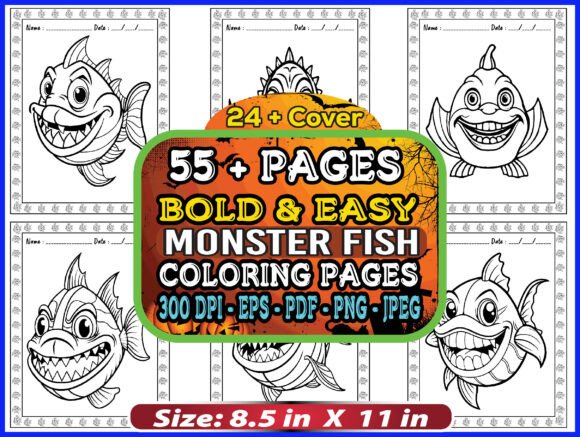
The Monster Fish Coloring Book for Kids is a digital printable coloring bundle designed for creators, educators, and independent publishers. It contains 55 original black-and-white coloring pages featuring imaginative, kid-friendly monster fish characters—each drawn with clear outlines and age-appropriate detail. The package is delivered as a downloadable .zip file and includes multiple file formats: AI (Adobe Illustrator), EPS, PDF, JPG, and PNG—all at 300 DPI resolution and sized to standard 8.5″ x 11″ dimensions.
This resource is intended primarily for those building print-on-demand (POD) products or preparing interiors for Amazon KDP publishing. Alongside the 55 interior pages, it also provides 24 customizable cover background options in the same high-resolution formats, supporting both front-cover design and branding flexibility.
Who Might Consider This Bundle?
Independent creators exploring low-overhead publishing may find value here. Because the files are ready-to-use and pre-formatted, users can avoid hiring designers for basic layout work—especially when launching a themed coloring book quickly. Educators or therapists seeking themed activity materials may also evaluate this bundle for classroom use or therapeutic coloring sessions, though its primary orientation is commercial publishing rather than curriculum integration.
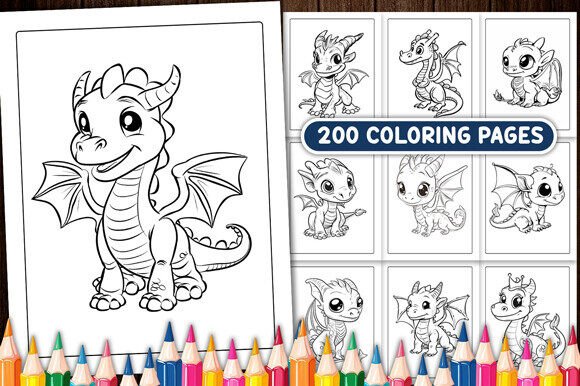
It’s worth noting that while the designs are labeled “monster fish,” they lean toward playful, non-scary interpretations—suitable for children aged 4–10. The line work avoids excessive complexity, balancing visual interest with accessibility for developing motor skills.
Practical Benefits of the Monster Fish Coloring Book for Kids
- Format versatility: Inclusion of AI and EPS files allows for editing in vector-based software—useful for resizing without quality loss or adapting elements across projects.
- Print readiness: All PDF and JPG/PNG files meet standard POD requirements (300 DPI, CMYK-safe grayscale, bleed-free 8.5″ x 11″ layout), reducing prepress troubleshooting.
- Cover flexibility: With 24 background options—including variations in texture, pattern, and layout—users can test different visual directions before finalizing a cover.
- No recurring fees: Once purchased, the license permits unlimited use for physical and digital resale, subject to standard commercial-use terms (always verify the seller’s specific license agreement).
Tradeoffs and Considerations
While the bundle offers efficiency, it does not include editable text layers, custom fonts, or pre-designed full-cover layouts with title and subtitle. Users must add typography separately—either manually or using design tools like Canva or Adobe InDesign. Those unfamiliar with basic typesetting or KDP’s cover calculator may need to allocate extra time for formatting.
Additionally, the artwork is stylistically consistent but not differentiated by difficulty level. There are no labeled “beginner,” “intermediate,” or “advanced” pages—so educators aiming to scaffold skill development may need to curate selections manually. Similarly, the theme is narrow: “monster fish” limits cross-topic application (e.g., ocean science units may benefit from realistic fish illustrations instead).
Another consideration is market saturation. On Amazon KDP, thousands of coloring books exist under similar themes. Success depends less on the interior assets alone and more on differentiation through cover design, description clarity, keyword optimization, and audience targeting—not features included in the bundle itself.
When This Bundle Is a Strong Fit
This resource aligns well with goals centered on speed-to-market and format reliability. For example:
- A creator planning to publish multiple themed coloring books per month may use this bundle as one component of a broader catalog—relying on its consistency and technical readiness to maintain output pace.
- An illustrator expanding into POD but lacking time to draw 55 new pages from scratch could use these as a foundation, modifying or combining elements using the editable AI/EPS files.
- A small business owner developing branded activity kits for aquariums, marine centers, or summer camps might adapt the designs for handouts or supplemental print materials—leveraging the high-resolution files for crisp large-format printing.
When Alternatives May Be Worth Exploring
If your goal involves deep customization—such as integrating brand-specific characters, multilingual labels, or educational annotations—the editable vector files help, but you’ll still need design expertise. In such cases, commissioning original artwork or licensing from an illustrator with education-sector experience may yield more tailored outcomes.
Similarly, if you’re building a series with narrative continuity (e.g., a story-driven coloring adventure), this bundle’s standalone, non-sequential pages won’t support that structure. You’d need to develop supplementary content—like short captions or scene prompts—separately.
For classroom use where copyright compliance is strictly monitored, verify whether the license permits institutional distribution (e.g., printed copies for an entire grade level). Some commercial-use licenses restrict bulk physical distribution even for nonprofit settings.
Making a Practical Decision
To determine whether the Monster Fish Coloring Book for Kids meets your needs, ask three questions:
- What’s your primary output method? If you’re focused on KDP or other POD platforms and want technically sound, print-ready interiors fast, this bundle reduces friction. If you need interactive digital versions (e.g., with color-picker functionality), it won’t serve that purpose—PNG/JPG files aren’t inherently interactive.
- What’s your design capacity? If you’re comfortable placing text on covers, adjusting margins, and exporting correctly formatted PDFs, the bundle gives you full control. If you rely heavily on templates or automated tools, confirm compatibility with your workflow—some AI files require specific software versions.
- How central is the “monster fish” theme to your audience? Niche appeal works well when matched precisely—e.g., a Halloween-themed aquatic camp or a fantasy marine biology unit. But broad early-elementary audiences may respond better to mixed-animal themes, which this bundle doesn’t provide.
Finally, compare file scope with alternatives. Some bundles offer fewer pages but include bonus resources like activity guides or teacher notes. Others prioritize realism over whimsy. Reviewing previews—especially actual JPG/PNG samples, not just mockups—helps assess line weight, spacing, and overall clarity before purchase.
In summary, the Monster Fish Coloring Book for Kids is a functional, technically sound asset for creators prioritizing efficiency and standard-compliant outputs. Its value lies in executional readiness—not conceptual novelty. Evaluating it alongside your specific publishing goals, technical comfort, and audience expectations will clarify whether it supports your next step—or whether a more specialized or flexible alternative better fits your context.